Outcomes and undo
Record what happened on each queue item with the outcome wizard, and undo a just-recorded outcome.
By the end of this page you'll be able to work a queue item start to finish: say what happened, set the next reminder, and take it back within a minute if you picked the wrong thing.
Record an outcome
Open a row from the Today queue. The lead appears in the work panel on the right, headed by the patient and the treatment (Grace Taylor - Invisalign) with the due time beside it; click the name to correct it in place, or the treatment to pick another. If anyone has tried this enquiry before, the heading also says how many times (3 attempts) — every outcome already recorded on it, AI calls included. Below the heading, the Call Grace button dials the number shown on it, and the steps follow one at a time; Back returns to the previous one. Treatment (again), value, owner, mobile and email are edited in the Details block further down, under Recent activity.
Call the lead with the Call button, which carries their number, then answer How did the call go?: click We spoke or No answer (or press Y / N). If nobody picked up, Call again in the Quick action callback row under No answer logs the attempt and books the next try in one click, at the time Smileline picks, which the button shows, for example Call again · Wed 14 Oct, 12:05 (see When the next call is). If you spoke and agreed to call them back, the same row under They want to be contacted again later offers call-back times, and books the one you click. The number keys after the answers pick the button.
If the last call from this card was answered and you choose No answer, Smileline checks with you before saving: This call was answered and lasted 18:44. Choose We spoke to record the conversation, or Log No answer anyway if you didn't speak to them (someone else picked up, say). An answered call logged as No answer would count as a missed attempt in your reports and could start no-answer follow-ups. A call a voicemail picked up never asks. The outcome you record does not change a logged call's result. To fix an incorrect label, open Correct call result in Last call, choose We spoke on this call or Reached voicemail, then Save. This corrects only the displayed completed outbound call. It is recorded with your name in the audit log and takes priority over later AI results. If the call's result has changed since you opened it, refresh before saving. Email and message replies never relabel an earlier phone call.
If the lead left no mobile number, their email address takes the number's place and the round button beside it opens the Chat tab (with neither on file, the step says No phone number on file), and the step asks Did you reach them? instead. Reached (Y) leads to the same answers as We spoke, with Email pre-selected under How did you reach them. Not reached (N) offers only I sent a message and the give-up option, the reminder step offers Email (when they have an address) and Message — write back in their conversation — and Send msg & Continue is available straight away. The queue row reads First contact rather than First call. Add the number in Details and the call flow returns.
Pick what happened. After We spoke:
- They're thinking about it
- They want to be contacted again later
- They booked a consultation
- They're not proceeding
- They're going ahead with treatment — only once the consultation has happened (see If they're going ahead)
Then choose how you reached them under How did you reach them?, which is required and is what powers your contact-rate reporting.
After No answer:
- I called but didn't speak to them
- I didn't call — I sent a message
- Give up on this lead — not proceeding
Each option also answers to its number key, 1–5.
Finish the branch you landed on (see below) and click Done (or press D).
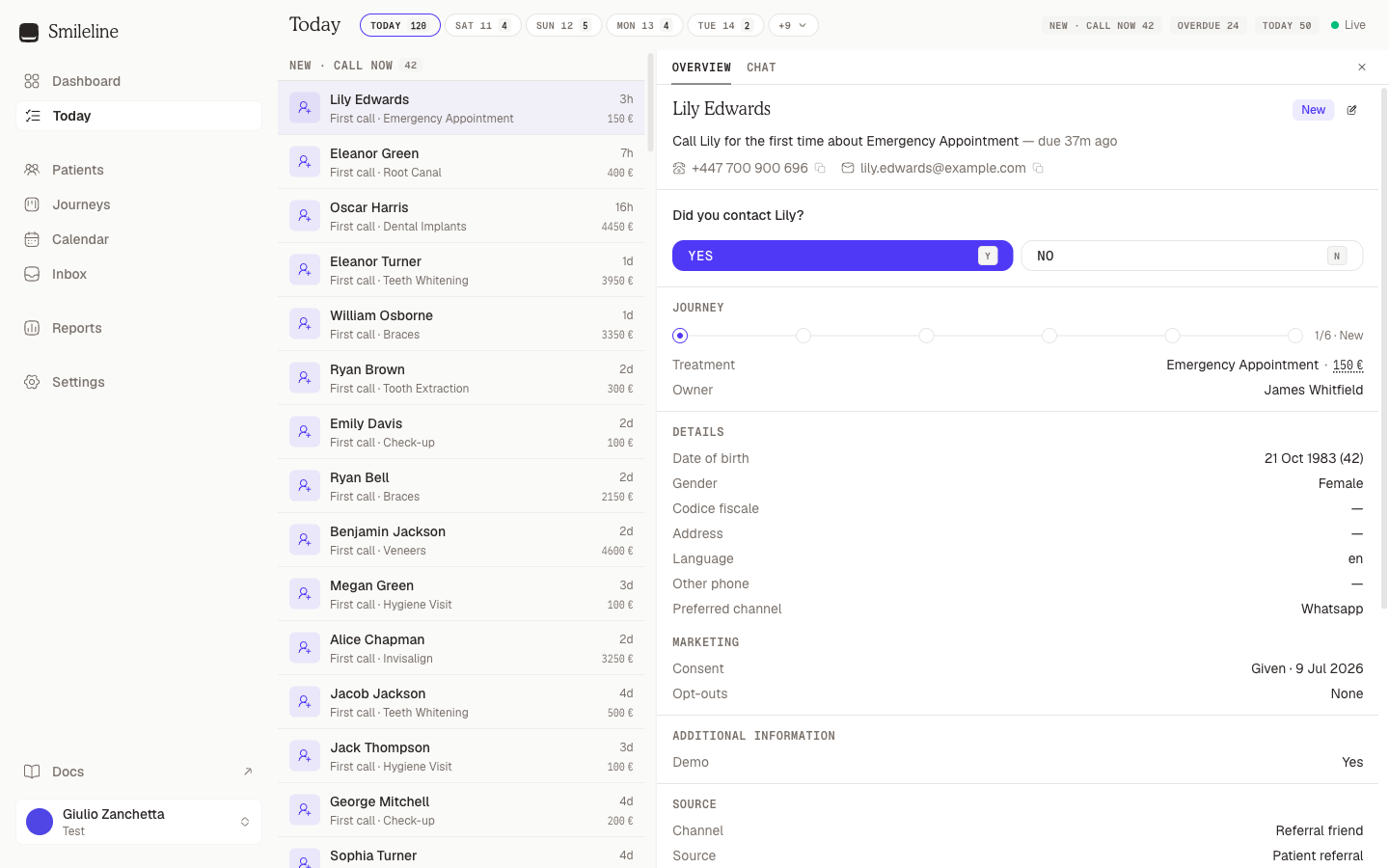
Once saved, the item leaves the queue and the panel automatically opens the next actionable item — you can work the whole queue without touching the mouse.
If they booked
The booked path asks When is the consultation?, then to Confirm the value (optional — it prefills the journey's estimate) and add a Team note. Click Done to finish. Booking moves the journey forward to your board's consultation-booked stage — and back to it from failed-to-attend when someone who missed their consultation books again — and the practice's booking messages go out, however it was booked.
The consultation date is what puts Did name attend their consultation? in the queue on the day, so the lead never goes quiet after it is booked. Done on this step is the booking itself: it stays greyed out, with Pick a time to book the consultation. under the slots, until you have chosen a slot or the step has found a booking the diary already holds — or, when your diary lives in a system Smileline cannot book into, until you have entered the date and time you booked there. A lead is never marked booked with nothing behind it.
When nobody knows their name
A caller Smileline could not match to anyone is listed as Unknown caller with their number beside it (Unknown caller · +44 7700 900123), so two of them never look alike. Once you click We spoke, the booked, reminder and not-proceeding steps ask for Their name — type it as they gave it (Ada Lovelace). Booking needs it: Done stays greyed out until there is a name. On the other steps it is optional.
The name is saved before anything else, so the consultation, the attendance question and a patient newly created in a connected system all carry it. Clicking the name at the top of the panel opens an empty box rather than "Unknown caller". If the caller later fills in one of your forms, books online or answers a lead ad with the same number or email, their name replaces Unknown caller by itself; a name somebody has already entered is never overwritten.
Book the slot without leaving Today
The step opens with a sentence — You are booking service for length — and both are yours to change. Picking another service changes the lead's service everywhere (the title of the panel and Edit patient details change the same one; the value is left as it is). The length starts at the service's own and only applies to this booking. A time already chosen is kept: changing the service leaves it exactly as it is, and changing the length keeps the same start when the longer (or shorter) consultation still fits there. When it would run into another booking or past working time, nothing changes yet — the diary opens on that slot at the new length, in red, so you can move it; Cancel leaves the consultation as it was.
Under When is the consultation? the step lists the next free slots — each with its day, time and the practitioner's avatar and name — long enough for this treatment's consultation. Click one and it is chosen; Done then books it and records the outcome in one go, so the appointment is in the diary with the journey's treatment on the card. There is no date to type for a site that uses Smileline's diary: a consultation always has a time and someone to see. If nobody works at the site yet, the step also shows Diary kept in another PMS? with a link to add it on Integrations.
How long a consultation takes comes from Default duration on Settings → Treatments; empty falls back to the appointment type whose default treatment it is, then 45 minutes. Who it can be with comes from the treatment's Consultation practitioners (none ticked means everyone at the site). Only practitioners assigned to the site are offered; one with no rota is offered inside the site's opening hours.
More times… opens the site's diary almost full-screen — the same grid as the clinical Diary, with a column per practitioner, the rota shaded and the day's bookings drawn:
- Move the pointer over the grid and an outline shows where the consultation would land, with its times and length written on it (13:30–14:30 · 60 min): green where it is free, red where it overlaps a booking or falls outside working time. The same label follows the slot while you drag or resize it.
- Click the date above the grid for three months at once, each day tinted by how full it is (Finding a free day); the tint counts the practitioners who can take this consultation, or the one the list is filtered to. +1W, +3M and +6M jump ahead.
- Click to place it — or drag over empty time to set its length too — then drag it to another time or practitioner, or drag its bottom edge for more or fewer minutes. The placed slot pulses green while it is free and turns red when it is not. The footer names the practitioner, When (the day and the time in one field — another day turns the diary to it) and Duration — all can be set there by keyboard — and asks for a room where the site books by chair.
- The Next free slots list beside the grid covers seven days at a time; filter it to one practitioner, or tick Show everyone at this site when the treatment narrows the list. With Anyone, the times are shared out between the practitioners who are free rather than all offered with the first. Each day has its own heading, which stays in view while you scroll, and every row repeats its date beside the time, next to the practitioner's avatar. Times that have already passed are never offered: the part of today behind the clock is greyed in the grid and turns red under the pointer, and when nothing is left today the list says so and starts at the next working day. Click a row and the consultation is placed there and the diary turns to that day and time.
- Use this slot brings the choice back to the step. A slot outside working hours asks you to confirm with a second click. A slot that overlaps another booking asks for a reason, which is kept with the appointment — anyone booking from Today can do this, whatever the diary's own overbooking rule.
Where the booking goes depends on the site:
- Own diary. The appointment is created in the same commit as the outcome. If the slot was taken in the meantime you are told so and asked to pick another.
- Connected practice-management system. When the patient's site is covered by a connected system, the slot is booked there first (the dialog says which system), and for Dentally and Open Dental the free times are that system's own working hours minus every booking Smileline already knows about, so the list and the colours on the grid always agree. Smileline's copy is listed at once and that system's answer replaces it, practitioner by practitioner, a moment later. A practitioner who is not linked there is named under the list and has no column to book in; if it cannot answer for someone, or for a length it does not search (under 5 or over 240 minutes), the list says that some times come from Smileline's copy of the diary. Today waits for the system to accept the booking, then records the outcome against that appointment; a rejected slot records nothing, and you pick another. A connected system will not take a slot that overlaps another booking. If the lead is not yet linked to that system, a dialog looks them up there by their email and number: pick their record, or — with Dentally — choose None of these — create in Dentally, fill in what Dentally still needs, and the booking carries on from where it stopped. Should it take longer than a minute to answer, the booking is safe: Check again in a moment, or Record without the booking to carry on with the slot as a date only.
- A system Smileline cannot book into. When the practice has requested its PMS on Integrations — a listed one, or its own name under PMS not listed — or a connection is still waiting to activate, the step says Book it in system, then enter the date and time here. Book the consultation in that system, type its date and time (in the practice's time zone) and click Done. The lead moves to consultation booked and the attendance question arrives on that day; nothing is added to Smileline's diary. The booking confirmation and the before-the-visit reminders still go out, counted from the date you typed, and if that date changes later the reminders follow it and the patient gets Appointment moved (see Bookings typed on Today).
Already in the diary lists the lead's upcoming bookings — reception may have booked the consultation already, or an undone outcome left one behind. Pick one instead of booking a second appointment.
The step also carries the Booking deposit card when Stripe is connected, so the deposit link goes out on the same call, and once it's paid the card shows the proof-of-payment link to copy into the booking — see deposit requests.
Whichever way the consultation was booked, marking the appointment attended or missed — in the Diary, by a connected system, or from the attendance question itself — answers the question once: the row leaves Today and the stage moves.
Booking from Today is a web feature. The mobile app keeps the plain date field.
If it's an attendance question
A Did name attend their consultation? row asks one thing:
- They attended (Y) — moves the journey to your board's consultation-attended stage.
- They're going ahead with treatment (G) — they came in and said yes: asks for the agreed value, then moves the journey to your board's going-ahead stage (see If they're going ahead).
- They didn't turn up (N) — moves it to failed-to-attend.
- Reschedule the consultation (R) — they asked to come in another day: moves the consultation and this question with it (see Move the consultation). Nothing is recorded as an answer.
- Give up on this lead — not proceeding (P) — closes it as not proceeding, exactly as elsewhere in the wizard, including the warning below the practice's minimum attempts. Its Set a reminder instead records the no-show and books the re-book attempt.
They attended and They didn't turn up then land on the reminder step, so you can book the follow-up call or the re-book attempt in the same pass.
The lead's number sits under the answers. Click it to call them, the same way as the Call button on other rows.
Move the consultation
Reschedule the consultation shows when the consultation is now, then asks for the new time:
- In Smileline's diary — pick one of the next free slots at the same site, or click More times… to open the diary. The slots are long enough for the visit as it stands, and its own time counts as free, so you can move it by half an hour. Change the length with the Duration menu.
- In Dentally or Open Dental — the same slot picker. Smileline asks your practice-management system to move the appointment, and the visit and the question move once it confirms. If it does not answer within a minute, Today says Sent to Dentally (or Open Dental) and moves on; the question follows when the move lands. If the system refuses the move, the step says why, so you can pick another time.
- In CareStack, or a system Smileline can only read — move the appointment there first, then enter the new date and time under Move it in CareStack, then enter the new time. The question moves now, and the next sync brings the appointment.
- With no diary appointment — enter the new date and time under When is it now?.
Add a Team note if you like; it goes on the timeline entry. Click Done (D) to save. The question leaves today's list and comes back on the new day. When the move is still on its way to the practice-management system, or it was refused or needs checking, the step says so the next time you open it.
In the mobile app, Reschedule the consultation has a date field. The visit keeps its practitioner, site, room and length.
However the consultation moves — here, by dragging it in the Calendar, through the patient's online reschedule link, by the AI receptionist, or in a connected practice-management system — its attendance question moves with it, and so do its reminders.
You can also answer this from the diary: marking the appointment Fulfilled or No-show in the Calendar moves the stage the same way, and so does a connected practice-management system.
When the consultation is an appointment in Smileline's diary, your answer also marks it there — Fulfilled for attended or going ahead, No-show for a missed visit — so the after-visit or missed-appointment message goes out. When it is held in a connected practice-management system, Smileline never changes it there, but your answer still decides which of those messages goes out — and it stands even if that system later says otherwise.
If they're going ahead
Going ahead is recorded once the consultation has happened, so it is offered in two places:
- On the attendance question, as They're going ahead with treatment (G).
- After We spoke, as the fifth answer (5), once the lead stands at your board's consultation-attended stage or past it. Before that the answer isn't offered, and Smileline refuses it if it is sent another way.
The step asks for the Agreed treatment value. It is optional and starts at the value last agreed for the lead, or its estimate when nothing was agreed yet: change it to the price the patient accepted. Add a Team note and click Done (or press D). No reminder follows. The lead moves to your board's going-ahead stage and shows Going ahead, and what waits for a patient going ahead starts: the follow-ups set to start then, the ad-platform conversion and the referral reward. They use the value you confirmed.
If they're not proceeding
The wizard asks you to confirm closing the lead as not proceeding. Add a Team note, then click Not proceeding — the button arms and asks once more: Confirm — closes this lead as not proceeding. A lead closed this way gets no follow-up task, and any of its remaining call-now cards leave everyone's queue.
When you spoke to them, click the Reason button that fits. Each reason has its own button with an icon. A reason is required, and you can pick only one: picking another clears the first, and clicking the picked one again clears it. Not proceeding won't close the lead until a reason is picked. Unable to contact isn't in this list: you spoke to them. If you pick Other, the Team note becomes Team note (required) — write why they're not proceeding before the lead will close.
When nobody ever reached them, the list isn't shown. The practice's reasons, such as too expensive or timing not right, describe something the lead said. Instead, Smileline records Unable to contact by itself, with the number of tries. The timeline shows it as, for example, Reason: Unable to contact · after 5 tries.
A spam or duplicate enquiry closes the same way. To keep it out of your ad-platform conversions, also choose Mark as junk… from its ⋯ menu on Journeys or on the patient record.
Giving up on a lead you never reached
Choosing Give up on this lead — not proceeding on a lead with fewer attempts logged than the practice's tries — nine unless changed in Settings → Not-proceeding reasons — opens a warning that names the count and offers the alternative:
- Set a reminder instead takes you to the reminder step, where you book the next call as usual. The attempt is still recorded.
- Close anyway — not proceeding turns the same dialog into a second step that asks why you are closing now. Write a reason and click Confirm — closes this lead as not proceeding; the button stays disabled until the reason is written. The reason is saved as the closing note, on the enquiry and in its timeline. Back returns to the warning. On the mobile app the same rule applies: the Team note must be filled in before Close anyway will close the lead.
Closing a lead this way, below the practice's tries, tells the practice's owners and managers: they get A lead is closed before the minimum tries in their notifications, with who closed it, after how many tries, and the reason written. Whoever closed it isn't notified. The rule holds wherever the lead is closed from — the web, the mobile app or the API — so a lead can't be given up on early without a written reason.
Press Escape to go back to the closing step unchanged. Once the minimum is reached the warning stops appearing and the arming button is the only confirmation. While the app is still loading the practice's settings, the warning appears whatever the count.
The count is the same one the card shows as 3 attempts: every outcome recorded on the enquiry, AI calls included.
Set the next reminder
Every other outcome ends on the reminder step:
- Remind me to — Call, SMS, Email or WhatsApp. A lead with no mobile number gets Email (when they have an address) and Message instead: a reminder to write back in their conversation, whichever channel it is on. Message is the only choice, and the one picked for you, for a lead who came in through a social comment or DM with no contact details.
- When — only after a conversation (They're thinking about it, They want to be contacted again later, They attended): pick the date and time the patient asked for, or one of the buttons under it, which follow your opening hours. A time outside opening hours is allowed when that is what the patient asked for. After No answer, I sent a message or They didn't turn up there is no When: Smileline sets it (see below).
- Assign the next task to — defaults to you; pick a teammate or leave it unassigned. A dentist, hygienist or nurse sees only clinic tasks, so they can't be given a lead's next task: the wizard says so, saves nothing and lets you pick someone else.
- Team note — anything the team should know.
A lead with no owner gets one when you record an outcome, whatever the outcome: the person the reminder is assigned to, or you when the reminder is unassigned or there is none. A lead that already has an owner keeps them — change the owner from the lead's Details block or the patient record.
Click Done to save. The reminder becomes a follow-up task that surfaces in the queue on its due day — every outcome that lands here leaves one, so no lead is left with nothing scheduled. If you do not want to chase this lead again, go Back and choose Give up on this lead — not proceeding instead.
When the next follow-up is
When you didn't reach the lead, Smileline books the next try itself, and the step names the day and time it picked, for example Next follow-up Wed 14 Oct, 12:05, set automatically within opening hours · try 4 of 9. The reminder wording covers calls, emails and messages; the selected channel above it says how you will follow up. The time is worked out when the step opens, so it moves on by however long you take to click Done. It follows your practice's call-back rhythm, three calls a day for three days unless you changed it:
- The tries are spread through the day: with opening hours of 09:00–18:00 and three calls a day, the next try is three hours later, so 09:05, then 12:05, then 15:05.
- Once the day's tries are used, or the next try would land after closing, it moves to the next opening, usually 09:00 the next working day. A try that would land in a lunch break moves to when you reopen.
- The hours are the lead's location's, in its time zone, from Locations. Closed days you added there, such as bank holidays, are skipped. A location with no hours set is treated as open weekdays 09:00–18:00.
- Every try counts towards the day, including AI calls.
The time appears in the outcome on the lead's timeline as soon as you click Done.
Change the time
To call at another time, click Change beside that line. The date and time field opens with the usual buttons under it; pick any time, even outside opening hours. Use the automatic time puts Smileline's choice back. Change isn't offered on the last try, or on Call again in the Quick action callback row.
When the time you pick is more than 2 working days away — counting the location's open days, so Friday to Tuesday is fine and Friday to Wednesday is not — the step says More than 2 working days away, so please add a short note. The team will get a notification. Done then needs a Team note saying why. The practice's owners and managers get A lead's next call is moved more than 2 working days away in their notifications, with your note. Weekends and other days the location is closed, such as bank holidays, don't count as working days.
The last try
The try that makes the practice's total closes the lead. On that try, No answer and I sent a message lead to That was the last try. instead of the reminder step, and Call again isn't offered. Add a Team note if you like and click Done: the lead closes as not proceeding with the reason Unable to contact and the number of tries, and no reminder is booked. Undo brings it back for a minute, like any outcome.
If No answer is logged on a call that was answered, Smileline still checks with you first, on the last try too.
Message them first
Send msg & Continue, beside Done, messages the lead before the reminder is saved. It appears once somebody has already tried this lead, or the lead has messaged the practice, so a brand-new enquiry gets a call first — unless the lead has no phone number, when it is there from the start. Write the message or insert a template, attach files if you like, and tick the channels to send on — every channel the practice has connected and the patient can be reached on is ticked to begin with (SMS is text only; WhatsApp carries the first attachment). Outside the 24-hour WhatsApp window the WhatsApp copy has to be an approved template, so the dialog asks you to pick one. Send & continue sends on each ticked channel, then saves the reminder exactly as Done would. If a channel fails, the dialog stays open showing why, and Retry failed sends only what did not go out. The messages land on the patient's conversation and timeline like any other.
Everything the wizard does — completing the task, stamping the journey's first contact, filling an empty owner, any stage move, the next task and the timeline entry — is saved in one go, so the patient's record always tells a consistent story.
The outcome then shows as one entry in the patient's activity, both in Recent activity on Today and on the patient record. It leads with what happened, such as We spoke or No answer, then shows your picks: how you reached them and what they said. Under those come any stage move, consultation, reminder and reason, then your team note. Your name is on it.
The stage shown beside the lead's name on Today is a read-out, not a control: it follows what you record here, what the diary says about the appointment, and what a connected practice-management system reports. To set a stage by hand, drag the card on Journeys or click a step on the journey's stage timeline on the patient record — moving a lead to consultation booked, attended or failed to attend opens this wizard or asks about the visit rather than just moving it (see Booked, attended and failed to attend).
Who gets the lead's chats
Every outcome also moves the lead's conversations to whoever follows the lead up, so their next reply alerts that person: the teammate the reminder is assigned to, or you when there is no reminder, it is unassigned, or that teammate can't take chats (see Who gets a conversation). They move even from a colleague, and Undo doesn't move them back.
If the conversations can't be moved, the outcome is still saved and a message says Couldn't move the chat to you. Click Assign to me on it to take them yourself, or assign them from the Inbox. The mobile app shows the same message on the outcome's confirmation, with Assign to me beside Undo. Tapping Assign to me keeps Undo available for the rest of its 60 seconds.
Call results can start follow-ups
Three results can start follow-ups when your practice has them set up: I called but didn't speak to them (and the Quick action callback row under No answer) on the Couldn't reach them step, and They're thinking about it and They want to be contacted again later on Spoke to them. An unanswered call can start different follow-ups depending on the attempt — the same count as the 3 attempts in the heading, including the one you are recording. The first try starts the First try follow-ups, as it moves the lead to Contact Attempted. This works the same on the web and in the mobile app.
The latest result wins: recording any new result on the enquiry stops follow-ups an earlier result started, then starts the new result's follow-ups, if there are some. Booking, going ahead, not proceeding and the attendance answers have no call trigger of their own: their follow-ups start from the stage they move the lead to, or from the lead going ahead or not proceeding.
Undo a just-recorded outcome
Clicked the wrong option? You have a moment to take it back.
After you click Done, a confirmation toast appears in the corner — for example, Outcome recorded, Consultation booked or Going ahead. When the outcome booked a slot, the toast also says that the diary booking stays: undo takes back the outcome, never the appointment. Cancel that from the diary, with a reason, if the slot was a mistake.
Click Undo on the toast.
The item returns to its place in the queue and reopens in the work panel. The task is reopened, any new follow-up task is cancelled, any follow-ups the outcome started are stopped and the earlier journey state is restored — an owner the outcome gave the lead is removed again, and so is a junk mark its not-proceeding reason added. The lead's conversations stay with whoever the outcome gave them to. The original outcome stays in the history, marked Undone, and an Undone: entry beside it names what was taken back, such as Undone: We spoke. Nothing is deleted.
Undoing They're going ahead with treatment also puts back the value agreed before, and an ad-platform conversion that hasn't been sent yet is never sent. If someone has changed the lead's value since, undo is refused. Once undo is no longer available, change the agreed value from the lead's value on the patient record: click the amount and type the right price. A lead that is going ahead is closed, so reopen it first, then record They're going ahead with treatment again with Log outcome.
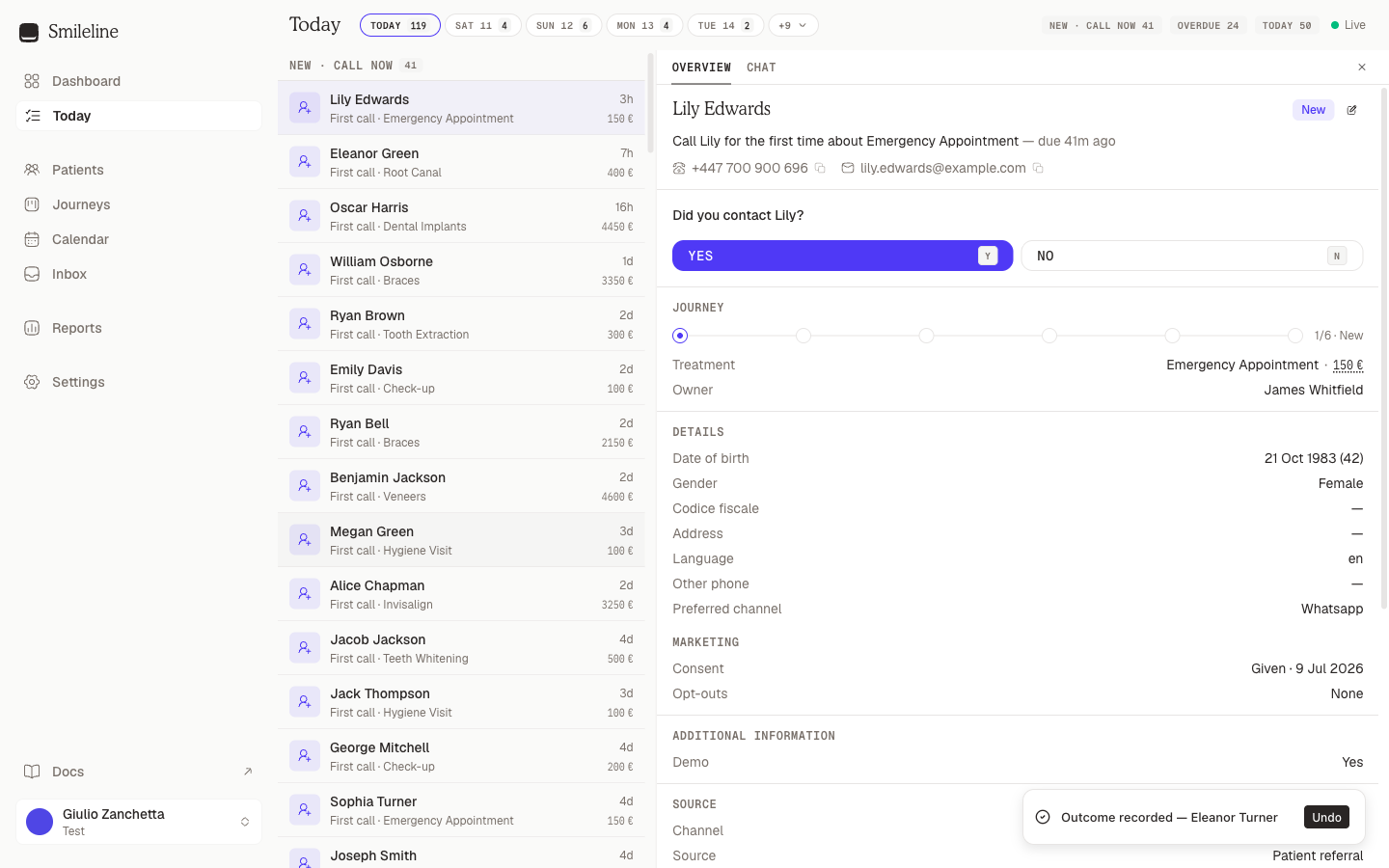
Undo is a 60-second window, and only the person who recorded the outcome can use it. A notification the outcome sent to the managers — a lead closed before the minimum tries, or a call moved more than 2 working days away — stays sent. An attendance answer that marked a diary appointment Fulfilled or No-show can't be undone: correct the appointment in the diary instead. When that answer was going ahead, reopen the lead to take it back. The toast shows for a few seconds — once it's gone, or once the journey has moved on for another reason, the undo is no longer available. After that, correct things from the patient's record instead.
If a teammate beats you to a lead, Smileline tells you: opening a lead someone else has open asks whether you want to take over, and recording an outcome on a task that was just completed shows an error and refreshes your queue. If the check on who has the lead open can't finish in time, nothing is saved: you're asked to try again, and what you entered stays in place.